> ## Documentation Index
> Fetch the complete documentation index at: https://help.lobyco.com/llms.txt
> Use this file to discover all available pages before exploring further.
# Post Coupons From an External Promotion Provider
> Push coupons into Lobyco from a third-party promotion provider.
This guide describes the options to import Offers and Coupons and assign them to specific customers in your loyalty program through integration. In this case you may have a need to feed these into Lobyco Promotion API by making them available to Lobyco features like: App Coupons, Continuity, Games etc.
## Offer flow via `Promotion API`
## Import offers from external systems
Offer import is possible from external systems, in case there is another system that can generate offers or allocate coupons.
* V2 Bulk import via [POST /promotion/v2/bulk/campaigns](/api-reference/promotion-platform/bulk-v2/post-v2-bulk-campaigns) - send a flat array of offers
* V2 Single import via [POST /promotion/v2/campaigns](/api-reference/promotion-platform/offers-v2/post-v2-campaigns) - create a single offer
* V3 Bulk import via [POST /promotion/v3/bulk/offers](/api-reference/promotion-platform/bulk-v3/post-v3-bulk-offers) - send a flat array of offers
* V3 Single import via [POST /promotion/v3/offers](/api-reference/promotion-platform/offers-v3/post-v3-offers) - create or update a single offer
## Create offers in the Lobyco Admin Tool
Creation directly in the Lobyco Admin Tool where an end user (e.g. marketeer) adds the necessary content regarding discount rules, thresholds, App presentation, and possible segmentation.
Field names in the available APIs and Admin Tool differ slightly, but they are still stored in the same fields in the DB, so it's safe to mix ways of creating and updating Offers.
To create a new Offer, a minimal number of fields has to be provided, including Offer Id, Name, Type, Valid From and Valid To dates. All other fields are optional during initial creation, but will be required when publishing the Offer.
When import as been successfully completed by either bulk or single load, the offers will be present in the Lobyco Admin. They will appear based on the defined parameters in the API call:
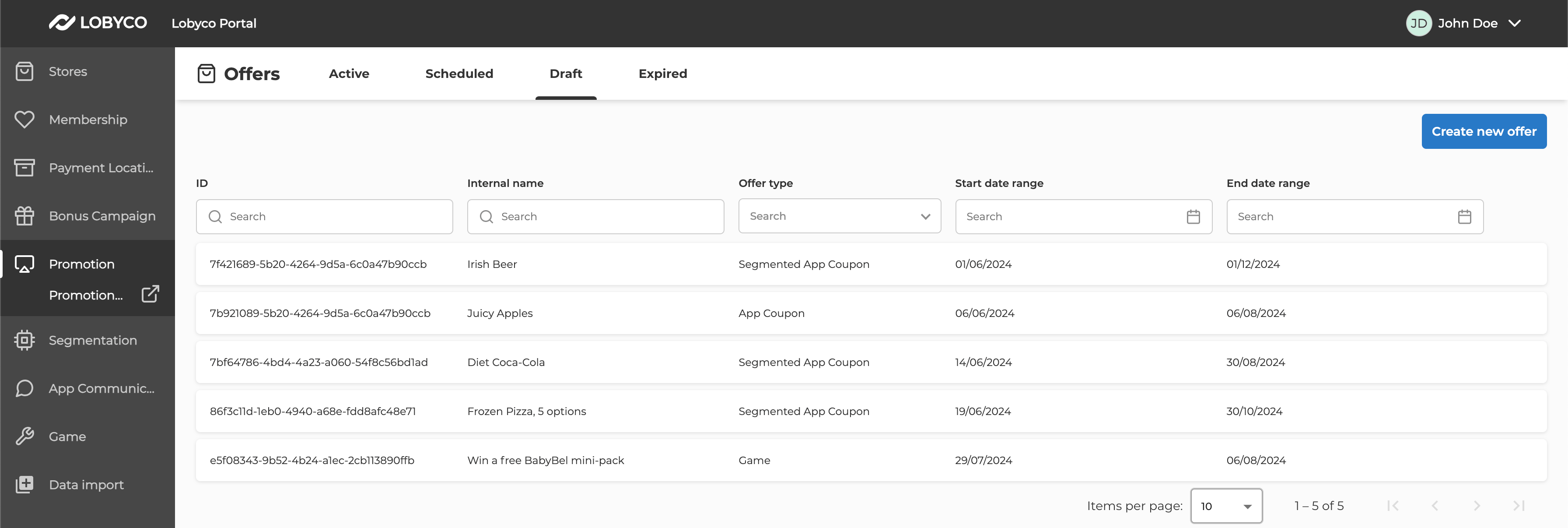 Screenshot from Lobyco Admin Portal - example of imported offers by API
## Publish an Offer
Before the Offer can be displayed in the app, you need to publish it. Before the Offer can be published, populate the following fields:
* Stores or Chains
* Title, description and imageUrl in content
* Discount details, including rule types and values, threshold types and values and list of impacted products and categories.
* Depending on discount types, you might need to specify more rules. See discount requirements section below or examples on any of the endpoints.
## Discount type requirements
### SimpleLine (Product Discount)
Product Discount should always have only a single rule defined. Included Product Ids or Category Ids have to be defined to Publish. `impactLevel` should be set to `Line`.
### SimpleTotal (Basket Discount)
Basket Discount should always have only a single rule defined. `impactLevel` should be set to `Total`. Only `Amount` threshold type is supported. For discount types, `FixedPrice` is not supported for basket, use any of the other 4 discount types instead. Excluded Product Ids or Category Ids are optional.
### SimpleQuantity (Threshold Discount)
Product Discount should always have only a single rule defined. Included Product Ids or Category Ids have to be defined to Publish. `impactLevel` should be set to `Line`.
### MixAndMatch (Mix & Match)
At least 2 rules have to be defined. Any combinations of threshold and rule types are supported. `impactLevel` should be set to `Line`. Included Product Ids or Category Ids have to be defined to Publish. Product Ids and Category Ids for each rule have to be unique. If you re-use the same Product/Category in 2 or more rules, Offer creation will fail. If you need to re-use the same Product in 2 rules, consider using some other discount type instead, like `SimpleQuantity`.
### MixAndMatchTotal (Mix & Match Total Value)
At least 3 rules have to be defined. `MaxNumberApplyPerReceipt` should always be 1. `impactLevel` should be set to `Total`.
This discount can have multiple precondition rules and single effect rule, that will be applied when all preconditions are satisfied. Precondition rules should have `thresholdValue` greater then 0, and they should all have the same `thresholdType`. Precondition rules ignore any rule types and values, for safety always set `type` to `Amount` and `value` to `0`.
A single calculation rule should be defined. Calculation rule should have `thresholdValue` equal to 0, and it does not support any Product or Category filters.
### QuantityStep (Quantity Tier)
At least 2 rules have to be defined. `ThresholdType` should always be set to `Quantity`. `MaxNumberApplyPerReceipt` should be at least as large as the maximum `thresholdValue` from the rules. All rules should have the same Product Ids and Category Ids defined. `impactLevel` should be set to `Line`.
### TotalStep (Basket Tier)
At least 2 rules have to be defined. `ThresholdType` should always be set to `Amount`. `MaxNumberApplyPerReceipt` should be always `1`. If Product Ids and Category Ids are defined, they should be the same among all rules. `impactLevel` should be set to `Total`.
## Assign coupons to customers via `Coupon API`
* Assign multiple coupons for a single offer to multiple customers in two ways
* Attach a segmentation file through the Admin Tool
* Populate `audienceId` in the `Offer` model
Screenshot from Lobyco Admin Portal - example of imported offers by API
## Publish an Offer
Before the Offer can be displayed in the app, you need to publish it. Before the Offer can be published, populate the following fields:
* Stores or Chains
* Title, description and imageUrl in content
* Discount details, including rule types and values, threshold types and values and list of impacted products and categories.
* Depending on discount types, you might need to specify more rules. See discount requirements section below or examples on any of the endpoints.
## Discount type requirements
### SimpleLine (Product Discount)
Product Discount should always have only a single rule defined. Included Product Ids or Category Ids have to be defined to Publish. `impactLevel` should be set to `Line`.
### SimpleTotal (Basket Discount)
Basket Discount should always have only a single rule defined. `impactLevel` should be set to `Total`. Only `Amount` threshold type is supported. For discount types, `FixedPrice` is not supported for basket, use any of the other 4 discount types instead. Excluded Product Ids or Category Ids are optional.
### SimpleQuantity (Threshold Discount)
Product Discount should always have only a single rule defined. Included Product Ids or Category Ids have to be defined to Publish. `impactLevel` should be set to `Line`.
### MixAndMatch (Mix & Match)
At least 2 rules have to be defined. Any combinations of threshold and rule types are supported. `impactLevel` should be set to `Line`. Included Product Ids or Category Ids have to be defined to Publish. Product Ids and Category Ids for each rule have to be unique. If you re-use the same Product/Category in 2 or more rules, Offer creation will fail. If you need to re-use the same Product in 2 rules, consider using some other discount type instead, like `SimpleQuantity`.
### MixAndMatchTotal (Mix & Match Total Value)
At least 3 rules have to be defined. `MaxNumberApplyPerReceipt` should always be 1. `impactLevel` should be set to `Total`.
This discount can have multiple precondition rules and single effect rule, that will be applied when all preconditions are satisfied. Precondition rules should have `thresholdValue` greater then 0, and they should all have the same `thresholdType`. Precondition rules ignore any rule types and values, for safety always set `type` to `Amount` and `value` to `0`.
A single calculation rule should be defined. Calculation rule should have `thresholdValue` equal to 0, and it does not support any Product or Category filters.
### QuantityStep (Quantity Tier)
At least 2 rules have to be defined. `ThresholdType` should always be set to `Quantity`. `MaxNumberApplyPerReceipt` should be at least as large as the maximum `thresholdValue` from the rules. All rules should have the same Product Ids and Category Ids defined. `impactLevel` should be set to `Line`.
### TotalStep (Basket Tier)
At least 2 rules have to be defined. `ThresholdType` should always be set to `Amount`. `MaxNumberApplyPerReceipt` should be always `1`. If Product Ids and Category Ids are defined, they should be the same among all rules. `impactLevel` should be set to `Total`.
## Assign coupons to customers via `Coupon API`
* Assign multiple coupons for a single offer to multiple customers in two ways
* Attach a segmentation file through the Admin Tool
* Populate `audienceId` in the `Offer` model